

Introduction
If you ask me what my number one place in Southern Africa is, I will list ten “number ones”. And on that list of favourites would be Livingstone, Zambia. Pictures and videos don’t do it justice! It is the co-host (with Zimbabwe) to one of the most beautiful and majestic waterfalls in the world, Mosi-oa-Tunya – “the smoke that thunders”! The site of nature in her element is a delight worthy of a million paragraphs, and the hospitality, joy, pride and earnest hard work of the locals are a sweet and most appreciated cherry on top!
So, did I take a flight from Joburg to Livingstone because a flight route existed? Or did a flight route exist because airlines know that people like me who appreciate the finer things in life are willing to make the trip from Joburg to Livingstone be it by plane or bicycle? Yes!
Both must happen simultaneously so that demand can incentivize the existence of network infrastructure and existing infrastructure can inspire travelers to consider air travel as an option for future trips. There are many such chicken-and-egg conundrums in the aviation ecosystem, and to help both you and myself remain sane, the following narrative may help knit everything together at a high-level, whilst simultaneously explaining how aviation acts as a multiplier for any economy.
High-level view of aviation operations
Regarding air cargo, Africa surpassed 2.4 million tonnes of cargo flown which is equivalent to 600 adult elephants
Let’s continue with the Johannesburg to Livingstone scenario. Imagine myself and many other passengers wish to take that journey, and in parallel, resorts in Livingstone wish to speedily ship in supplies from neighboring countries. We will refer to this as inherent demand, and in Africa its growth trajectory is quite encouraging.
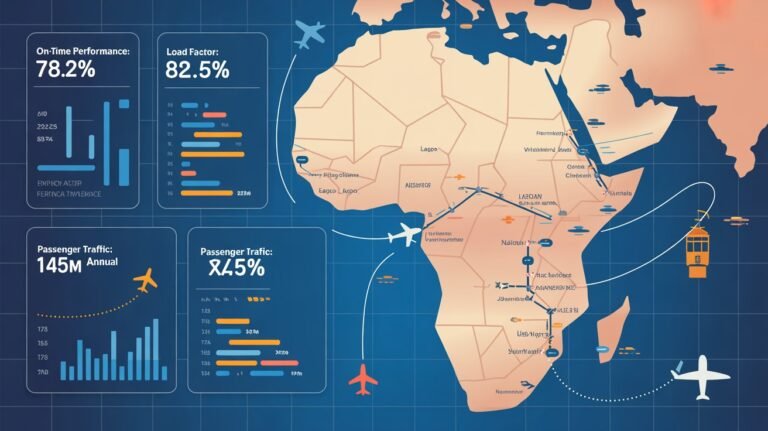
According to iba, Africa’s passenger volume was 113m in 2025 and is expected to reach ~140m by 2030, and a further 345m by 2043 as per IATA projections. That’s over 20% of the continent’s population today! Regarding air cargo, Africa surpassed 2.4 million tonnes of cargo flown which is equivalent to 600 adult elephants (a common sight in Livingstone by the way). Air cargo in Africa saw the fastest growth in September 2025 (14% growth) according to the IATA, but the growth was driven more by Africa-Asia routes and less by intra-continental trade.
Now in light of this inherent demand, if the existing network is robust enough i.e., sufficient flight capacity,
convenient direct routes, flights scheduled at a convenient time and reasonable layover times, flights are booked and paid for and we refer to that as demand capture.
Regarding the flight capacity in Africa’s network, iba reports Africa having 1 490 aircraft in service with close to half (44%) being narrow-bodies, 23% being turboprops, 19% being regional jets and wide-bodies driving only 14% of the fleet. This implies a strong focus on domestic, or regional travel (86% of fleet). However, the narrow-body dominance further implies airlines are servicing thin routes with lower demand capture potential, making narrow-bodies with less seats more economical.
Regarding the channels through which that demand is captured, only 30% of travel sales happen online via the aircraft carrier vs the global average of 50%. The remaining 70% of sales are predominantly through travel agent.
Figure 1 – Interaction between demand and network leading to demand capture
Demand capture is crucial for airline economics and the higher it is, the higher the air traffic driven by that airline in terms of Revenue Passenger Kilometers (RPK) and Cargo Tonne Kilometers (CTK).
RPK is passengers x km flown summed across flights that year; CTK is tonnes of cargo x km flown summed across flights. Both are critical traffic KPIs for airlines.
Higher traffic drives two key effects, one: load factors go up (i.e., percentage of flight capacity sold), and two: aircraft utilization goes up (i.e., percentage of time spent by the aircraft in flight vs on the ground). The result is improved unit economics due to lower costs per passenger or tonne, which ultimately drives down airfare.
A lower airfare has positive knock-on-effects on the number of travelers willing to consider air travel, and evidence suggests that effect is more pronounced in Africa than in other regions. The IATA conducted an analysis on regional traffic showing that in Africa, 94% of passengers where in economy cabins versus premium and Africa is seeing the slowest growth for Premium cabin sales. Premium is growing at 5.6% YoY in Africa compared to 23% for Asia Pacific, 22% for Latin America and 11% in the Middle East. This points to African passengers being more price conscious than other regions, implying an highly elastic aviation market.
In fact, an empirical study shows that a $1 increase on a $100 fare for a specific route in Africa could make up to 3 passengers out of 100 opt out of flight as a mode of transport! That is how price conscious we are!
So conversely, if an increase in traffic (RPK and CTK) means improved unit economics and LOWER airfare, it wouldn’t be far fetched to expect HIGHER inherent demand to fly.
Figure 2 – Traffic improving unit economics and driving higher demand
High-level view of investment & economics
Africa requires between US$25–30 billion over the next decade to close critical aviation infrastructure gaps
So far the narrative has been focused on the operations side of aviation, however financial investment in the industry as well as economic impact of the industry are also factors to consider.
Using the same example, as more traffic is seen between Johannesburg and Livingstone, more frequent and stable cash inflows are seen by the airlines servicing the routes and both the airports involved. As a result, both these entities now have the means to invest in operational improvements either through more frequent and thorough maintenance, high quality training for crews, or capability improvements. Maintenance, repairs and overhaul (MRO) alone is often a hefty cost centre. According to AFRAA, in recognition of this challenge, five African airlines (Royal Air Maroc, Ethiopian Airlines MRO, EgyptAir, Kenya Airways, and SAA Technical) aim to pool together their MRO capabilities to enable airlines to save on costs by using local facilities versus maintenance outside the continent. The savings potential is staggering, with Nigeria alone spending over US$2.5 billion annually on foreign aircraft maintenance.
Beyond investing in everyday operations, with more cash inflows, airlines and airports are more likely to investment in infrastructure and capacity expansions or upgrades. The steady revenue streams also increase financier confidence and make fundraising for such upgrades more feasible.
Based on a Continental Aviation Infrastructure Gap Analysis conducted with the African Civil Aviation Commission (AFCAC), the International Civil Aviation Organization (ICAO), and the World Bank, Africa requires between US$25–30 billion over the next decade to close critical aviation infrastructure gaps. From a fleet capacity perspective, Boeing estimated that Africa will need 1 200 aircraft over the next 20 years which is approximately 60 aircraft a year. However, AFRAA annual reports show that historically, Africa has only managed half that (~31 aircraft) each year on average between 2018 and 2025.
Closing the funding and aircraft acquisition gap is crucial to achieve more robust operations and better flight scheduling, which in turn works to build a stronger air travel network! See how we came full circle there?!
Figure 3 – Investments driven by cashflows from increased traffic (slide 1), Historical trends of number of new aircraft delivered each year per region between 2018 and 2025 (slide 2)
Now that we have considered the investment side of aviation, we can wrap up with looking into the economic impact. Increased traffic inherently means that region is experiencing freer and faster movement of both goods and people. That low friction mobility is often a key enabler for robust trade between nations or regions as well as reliable supply chains for businesses.
When looking at trade within the African region, GIZ 2022 publications show that only 17% of all trade was within the African continent. This is a stark difference with other regions. Intra-continental trade makes up 51% of exports in North America, 49% in Asia, 22% in Latin America, and a whopping 69% in Western Europe.
However, when trade is done optimally within the continent, a crucial knock-on-effect is that new businesses are more likely to be established and already established businesses are more likely to consider expansions across African regions. That in turn has a positive impact on both economic growth and job creation. When the local population is skilled enough to fill those positions, standard of living and purchasing power of the ordinary citizen increase. Higher purchasing power implies more disposal income, INCREASING inherent demand for air travel!
Figure 4 – Travel demand increase driven by economic growth and increase in disposable income
Final thoughts
Figure 5 – Complete view of the aviation framework
This high-level framework describing the aviation ecosystem demonstrates that ranking the inputs in order of priority is an exercise in futility. The truth is all elements need to work together simultaneously to ensure and industry is firing on all cylinders! The implication is that because the system is so tightly interlinked, it is only as strong as it’s weakest link.
So the question you may be pondering now is “How strong is Africa’s aviation ecosystem?”. We’ve got you covered! In our next article, “Africa? The Doctor Will See You Now – An Industry Health Check”,
we explore the crucial KPIs that help us determine the health of the industry, and we will examine each KPI for Africa.
At first glance, unpacking the aviation industry may seem like a giant convoluted task, but we will use this framework to systematically drill down to the crucial issues piece by piece, which enables you to systematically brainstorm solutions from the comfort of your couch … or wherever else you’re reading this from 😉